 How-to
How to Track Progressive Overload Without Supplements
Last Updated: November 4, 2026
Quick Summary
Track progressive overload without supplements by recording five things per exercise: load, reps, sets, effort level, and date. Use double progression, adding reps first and then weight once you hit the top of your rep range on all sets with clean form. Change one variable at a time and give it two to three sessions before judging.
- A progressive overload tracking sheet records load, reps, sets, effort level, and date for each exercise.
- Add 5 lb to upper-body lifts and 10 lb to lower-body lifts once you hit the top of your rep range.
- For bodyweight movements, add reps first, then a set, then slow the tempo before adding load.
- A 5-10% swing in reps or load between sessions is normal noise, not a real change in fitness.
- Deload by reducing load about 10% when effort ratings stay at 9-10 for two weeks.
Table of Contents
- What Progressive Overload Means and Why It Drives Strength
- What to Record in a Progressive Overload Tracking Sheet
- Free Apps to Track Progressive Overload Without Paying for Supplements
- A Progressive Overload Example You Can Copy This Week
- How to Track Progressive Overload at Home With Minimal Equipment
- Progression Rules for Different Exercises and When to Increase Weight or Reps
- Tell Real Progress From Day-to-Day Noise and Break Through Plateaus
- Start Your First Tracked Week With Dialed In
- Frequently Asked Questions
What Progressive Overload Means and Why It Drives Strength
Progressive overload is the practice of gradually asking your muscles to do more work over time.
Muscle growth happens when training stress slightly exceeds what your body has already handled.
The American College of Sports Medicine position stands on resistance training support this progression principle for healthy adults.
EXTERNAL_LINK: 6 Ways to Build Muscle Without Supplements covers the wider no-supplement playbook this section assumes.
What to Record in a Progressive Overload Tracking Sheet
A progressive overload tracking sheet records five things per exercise: the load, the reps, the sets, the effort level, and the date. Everything else is optional. Get these five right and you can see progress on paper, in a spreadsheet, or in an app.
Here's the minimum viable entry for each exercise:
- Exercise name (bench press, goblet squat, row)
- Weight used (in pounds, same unit every time)
- Reps per set (write "8/8/7," not "about 8")
- Sets completed (vs. sets planned)
- Effort rating (a simple 1-10 scale works)
- Date (so you can spot trends over weeks)
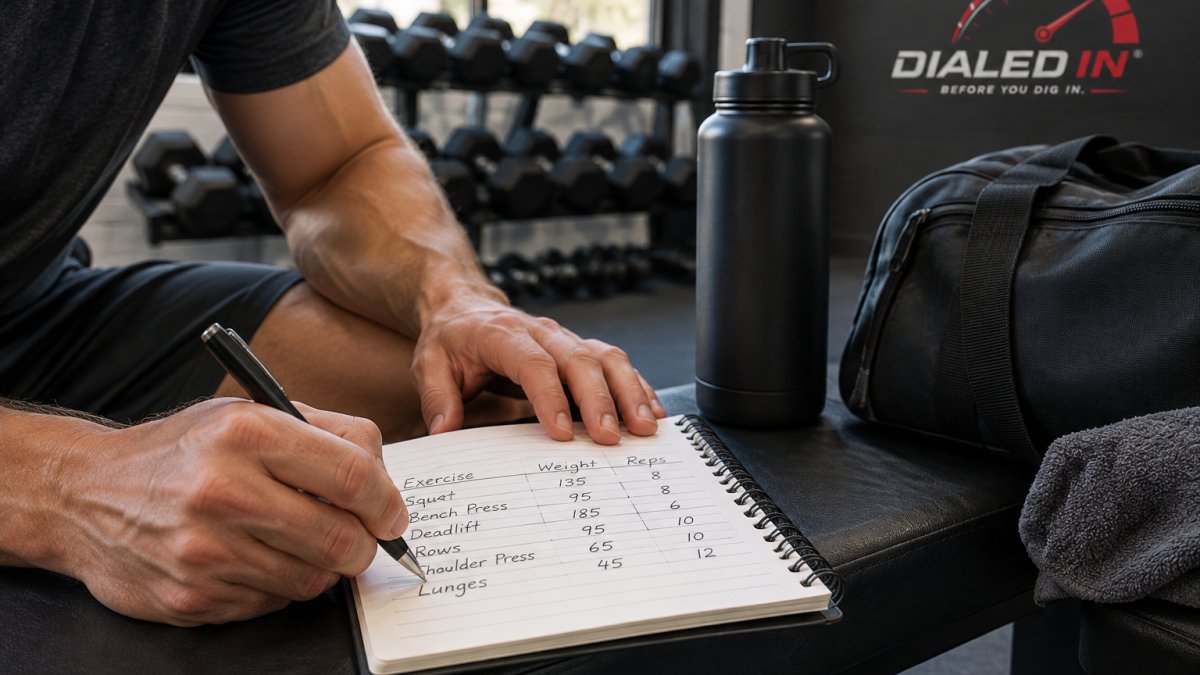
A common mistake is logging only the top set. The last set tells you more about fatigue than the first. Record every set and you'll know when to push and when to back off.
A Copyable Log You Can Start Today
You do not need an app to begin. Copy this header into a notebook or spreadsheet and fill one row per exercise per session:
| Date | Exercise | Load (lb) | Set 1 | Set 2 | Set 3 | Effort (1-10) | Notes |
|---|---|---|---|---|---|---|---|
| 11/04 | Bench press | 135 | 8 | 8 | 7 | 8 | Felt strong, bar path clean |
| 11/04 | Goblet squat | 50 | 10 | 10 | 9 | 7 | Knees tracked well |
That single row captures everything you need to apply double progression next week. If you hit the top of your rep range on all sets at the same load, you earn a small increase. If not, you repeat the load and add reps.
Progression Rules by Exercise Type
Adding weight is not always the right dial. Use the rule that fits the movement:
- Large compound lifts (squat, bench, deadlift, row): Add 5 lb to upper-body lifts and 10 lb to lower-body lifts once you hit the top of your rep range on every set with clean form. If form breaks down on the last set, hold the load and build reps first.
- Isolation moves (curls, lateral raises, leg extensions): Use the smallest jump your gym allows, often 2.5 lb. These muscles respond to small, repeated increases, and big jumps usually turn into swinging.
- Bodyweight movements (push-ups, pull-ups, dips): Add reps first, then add a set, then slow the tempo. When reps top out cleanly, add load with a backpack or belt rather than rushing to a harder variation.
- Core work (planks, carries): Progress by time or distance before adding load. A steady 60-second plank that feels easy is a signal to add 10 seconds, not to grab a plate.
EXTERNAL_LINK: Is Macro Tracking Necessary for Muscle Gain? answers whether you need to log food alongside your training numbers.
Watch out: if you change two variables at once, say, adding weight and adding a set in the same week, you will not know which one caused the progress or the stall. Change one dial at a time and give it two to three sessions before judging.
Free Apps to Track Progressive Overload Without Paying for Supplements
The best free apps for tracking progressive overload are simple workout loggers that store your history and show last session's numbers. Supplements cost money.
Most free fitness apps share the same core: an exercise library, a place to enter weight and reps, and a history view. The features worth checking before you commit:
- Offline logging (gyms have bad signal)
- A "last time" view for each exercise
- Simple export or backup
- No paywall on basic logging
A paper notebook beats a cluttered app for many lifters. The tool matters less than the habit of recording every session. Pick one and use it for a month before judging it.
Watch out: free apps often lock history or charts behind a subscription. Check that your data stays visible before you log months of workouts.
A Progressive Overload Example You Can Copy This Week
Here is a progressive overload example for a beginner squatting twice a week. It uses double progression, which means you add reps first, then weight.
The rule: stay at one weight until you hit the top of your rep range on all sets. Then add load and reset the reps. This keeps effort consistent and progress measurable.
Apply the same pattern to a push, a pull, and a lower-body lift. Three exercises, tracked the same way, is enough to start.
How to Track Progressive Overload at Home With Minimal Equipment
At home, track progressive overload by changing reps, sets, tempo, and rest before you change weight. Bodyweight training responds to these dials just as well as a barbell does.
Use this order of progression for home workouts:
- Add reps to each set within a target range.
- Add a set once reps top out.
- Slow the tempo to increase time under tension.
- Shorten rest between sets.
- Add load with a backpack, band, or heavier household item.
Record the same fields as a gym log: exercise, reps, sets, effort, date. A notebook on the floor works fine.
Many people find that home progress feels slower because the load jumps are smaller. That's normal. Smaller jumps are easier to recover from.
Progression Rules for Different Exercises and When to Increase Weight or Reps
Increase weight when you hit the top of your rep range on every set with good form. Increase reps when you are still below that ceiling.
| Exercise type | Progress by | When to add load | Watch for |
|---|---|---|---|
| Large compound lifts | Weight, then reps | All sets hit top of range | Form breakdown |
| Bodyweight moves | Reps, then sets | Reps top out cleanly | Rushing the tempo |
| Isolation moves | Small weight jumps | Top of range, all sets | Swinging the weight |
| Core work | Time or reps | Steady hold gets easy | Losing position |
For compound lifts, small jumps work best. For isolation work, even smaller jumps. For bodyweight moves, reps and sets come first.
A common mistake is chasing a new weight before earning it. If your last set collapses to half the reps, the jump was too big. Back off and build the reps first.
Tell Real Progress From Day-to-Day Noise and Break Through Plateaus
Real progress shows up over weeks, not days. A single bad session is noise. Three weeks of flat numbers is a signal. Learn the difference and you'll stop panicking over one rough workout, and you'll stop blaming your lack of supplements for a normal dip.
Separating Noise From Signal
Day-to-day performance moves for reasons that have nothing to do with your program: sleep debt, stress, hydration, technique changes, and normal variability. A common pattern is a 5-10% swing in reps or load from one session to the next with no real change in fitness. Before you change your plan, check three things:
- Same conditions? Compare sessions at the same time of day, with similar food and sleep, and on the same equipment.
- Same technique? A wider stance or faster tempo can add reps without adding strength.
- Same effort? An effort rating that dropped from 9 to 7 means you left reps in the tank, not that you got weaker.
If two or three sessions in a row show the same numbers under similar conditions, that is a signal. One session is noise.
Signs of Real Progress
- More reps at the same weight across all sets for two or more weeks
- Better form on video at the same load
- Shorter rest needed for the same work
- Clothes fit differently even when the scale stalls
Plateau Troubleshooting and Deload Decisions
When a true plateau hits, change one variable at a time. Use this order:
- Hold the load and add a rep on the set that stalled.
- Add a set to the exercise if reps are maxed out.
- Take a lighter week, reduce load by about 10% and keep the same reps, if effort ratings stay at 9-10 for two weeks and sleep or mood is slipping.
- Change the exercise variation only after the first three steps fail for three weeks.
A planned easy week often breaks a stall faster than grinding harder. Deload when effort is high, reps are flat, and recovery feels poor, not because one workout felt heavy.
Recovery Without Supplements
Recovery basics matter here, and they don't require supplements.
Food does the job supplements are marketed for: protein at meals, carbohydrates around training, and enough total calories to support the goal.
EXTERNAL_LINK: How to Track Body Recomposition Progress Without a Scale covers other ways to measure progress beyond the gym numbers.
Watch out: if you deload every time a session feels hard, you will never accumulate enough training stress to progress.
Start Your First Tracked Week With Dialed In
Tracking progressive overload is a training habit, but it only pays off when recovery and food support it. That's where Dialed In fits.
- Personalized picks based on your fitness goal
- Works on any menu, meal, or fridge item
- No calorie counting required
For more practical, science-backed guides on food decisions, browse the Smarter food decisions, one plate at a time hub. If you need setup help during your first tracked week, the support page has answers.
The challenge is simple: log every set for four weeks and let the numbers, not guesswork, guide your next jump. Get started with Dialed In and make smarter food choices that back up your training.
Frequently Asked Questions
What is the best way to track progressive overload?
Pick one log you will actually use every session: a notebook, a spreadsheet, or a free app. Record the exercise, the weight, the reps per set, and how hard the last set felt. Then apply a fixed rule, like adding one rep per set before adding weight. The best method is the one you fill in consistently, because a training log only works if the entries are complete enough to compare week to week.
What is the 2 for 2 rule for progressive overload?
The 2 for 2 rule means you add weight once you can complete two extra reps on your top set for two workouts in a row. It stops you from jumping load after one good day. Example: if you bench 135 pounds for 8 reps, then hit 10 reps in two consecutive sessions with clean form, add 5 pounds and rebuild from there. It is a simple, supplement-free trigger for increasing weight.
Can I track progressive overload at home without an app?
Yes. A notebook and pen work fine. Write the date, exercise, load or band tension, reps, and sets, plus a one-word effort note like easy, solid, or grind. For bodyweight work, record total reps and range of motion, such as push-ups on a lower surface. Review the page before each session and beat one number. Apps help with charts, but paper removes friction and costs nothing.
How do I know when to increase the weight or reps?
Increase reps first inside your target range, then add load. If your plan calls for 8 to 12 reps and you hit 12 on every set with clean form and two reps left in reserve, add the smallest available increment next session. For upper body that is usually 2.5 to 5 pounds; for lower body, 5 to 10 pounds. If form breaks down, hold the weight and repeat the week.