 Listicle
Best AI Nutrition Apps for Restaurant Menus
Table of Contents
- Best AI Nutrition Apps That Scan Restaurant Menus for Protein Goals
- How AI Food Scanner Apps Work for Restaurant Menus
- AI Nutrition App for Restaurants: Finding High-Protein Options
- Protein Tracking App Features That Matter
- High-Protein Restaurant Meals: Real-World Testing
- Dialed In: No-Logging AI Coaching for Any Menu
- Free vs. Paid: What You Actually Get
- Common Mistakes When Using Nutrition Apps at Restaurants
- Frequently Asked Questions
Last Updated: October 18, 2026
Best AI Nutrition Apps That Scan Restaurant Menus for Protein Goals
AI nutrition apps restaurant menus combine real-time food recognition with personalized macro tracking, eliminating manual entry and delivering recommendations at the moment of decision for protein goals.
This guide covers which app actually works at the restaurant table and which helps you hit protein targets without obsessive tracking.
Quick Picks:
- Best Overall: Dialed In, real-time AI coaching with no logging required
- Best for Speed: Amy Food Journal, meal logging in 5-10 seconds per meal
- Best Database: Nutritionix Track, 540,000+ food items including restaurant menus
- Best for Meal Planning: Strongr Fastr, AI-powered weekly meal planning around nutrition goals
Quick Comparison Table
| App | Approach | Best For | Key Limitation |
|---|---|---|---|
| Dialed In | Real-time AI coaching, no logging | Restaurant diners who hate tracking | Limited free trial access |
| Amy Food Journal | Fast photo + voice logging | Busy professionals | No restaurant menu scanning |
| Nutritionix Track | Large food database | Broad restaurant coverage | No real-time coaching |
| Strongr Fastr | Weekly meal planning | Meal prep and planning | Not real-time at restaurants |
| MyFitnessPal | Comprehensive food + fitness tracking | All-in-one fitness tracking | Requires manual logging |
How AI Food Scanner Apps Work for Restaurant Menus
AI nutrition apps that scan restaurant menus use two core technologies: image recognition and a verified food database. Point your camera at a plate or menu and the app identifies the food, estimates portion size, and retrieves nutritional data. Accuracy depends on database size and how well the AI handles real-world restaurant photography.
The best AI food scanner apps for restaurants combine photo recognition with voice and text logging as fallbacks, since restaurant lighting creates shadows and plated dishes don't always match training images.
Photo-Based Food Recognition
Photo recognition matches the image against thousands of reference photos, pulling nutritional data for each recognized component. But restaurant plating is rarely standardized: a "grilled salmon" looks different everywhere, portions vary wildly, and mixed dishes contain ingredients the camera can't distinguish.
According to research from Cornell's Food and Brand Lab, visual estimation of portion sizes is accurate within 15-25% for simple, single-component foods but drops to 30-40% error for mixed dishes. This means a restaurant burrito bowl could be off by hundreds of calories depending on how much rice versus protein is actually in there.
The best apps acknowledge this limitation upfront. They don't pretend photo recognition is perfect; instead, they let users adjust portion size sliders after the initial scan. Dialed In handles this by asking clarifying questions about the meal composition rather than locking in an estimate based on the photo alone.
Real-Time Macro and Calorie Estimates
Once the app identifies the food, it pulls protein, carbs, and fat data from its database. Accuracy is critical: a chicken breast labeled 150 calories might be 200+ if buttered or sauced, and the estimate is only as good as the underlying database entry.
Real-time macro estimates are most useful when the app provides a confidence score, showing "high confidence" for packaged foods and "medium confidence" for restaurant dishes. This transparency helps users know when to trust the estimate and when to adjust it.
AI Nutrition App for Restaurants: Finding High-Protein Options
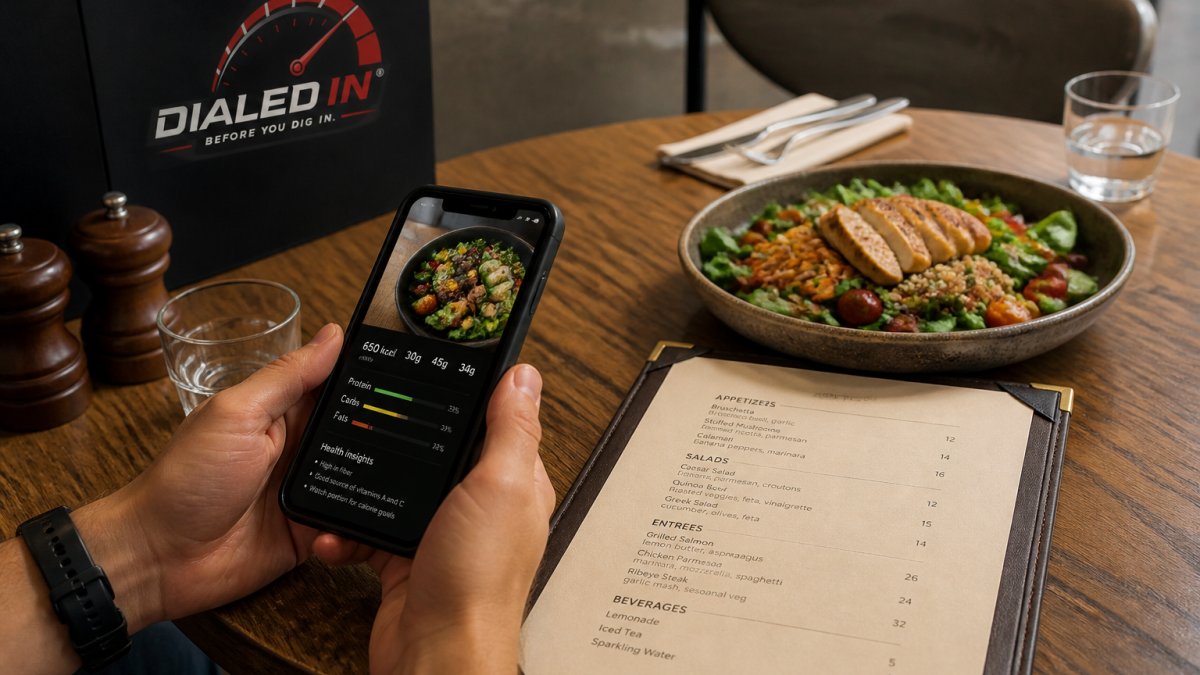
The real test of AI nutrition apps restaurant menus isn't tracking what someone ate, it's helping them choose before they order. The best apps scan a restaurant menu photo, identify the dishes, and highlight high-protein options aligned with the user's goals.
Dialed In excels here by analyzing menus in real-time and recommending dishes that hit protein targets without manual logging. Point your camera at the menu beforehand and get personalized recommendations, shifting the app from a tracking tool to a decision-making tool.
A traditional calorie-counting app requires you to decide, find the dish in the database, log it, check it against your goals, and adjust. Dialed In flips this: point your camera at the menu, get personalized recommendations instantly, and order with confidence.
Protein Tracking App Features That Matter
A basic calorie counter might show total protein grams, but the best apps for muscle-building goals go deeper: they show protein distribution across meals, flag when you're underhitting your daily target, and suggest high-protein swaps in real-time.
Macro Targets vs. Simple Calorie Counting
Calorie counting alone doesn't guarantee good nutrition: someone could hit 2,000 calories while getting only 80 grams of protein. The best AI nutrition apps for protein goals let users set specific macro targets (e.g., 150g protein, 200g carbs, 60g fat) and track against them.
Dialed In recommends specific meals that align with daily targets in real-time rather than logging meals and checking totals at day's end. Tracking tells you if you missed your goal; coaching helps you hit it before the day ends.
Accuracy Limits and Estimation Gaps
All food-logging apps have accuracy limits. A "grilled chicken salad" could range from 300 to 600 calories depending on dressing and portion, and the app can't know these specifics from a photo or menu description.
The best apps are transparent about this, showing confidence levels, allowing manual adjustments, and acknowledging that restaurant estimates are educated guesses. Dialed In handles uncertainty by asking clarifying questions rather than locking in a single estimate.
Common estimation gaps include:
- Cooking oils and butter used in preparation
- Sauce thickness and coverage
- Actual portion size relative to the photo
- Hidden ingredients in mixed dishes
When an app claims 95% accuracy for restaurant meals, that's a red flag. Restaurant food is inherently variable. An honest app acknowledges this and focuses on directional accuracy, getting close enough to make good decisions, rather than precision that's impossible to achieve.
High-Protein Restaurant Meals: Real-World Testing
The real test of an AI nutrition app is whether it helps someone hit protein goals when eating out. Consider a user who wants 150 grams of protein for the day with one meal left.
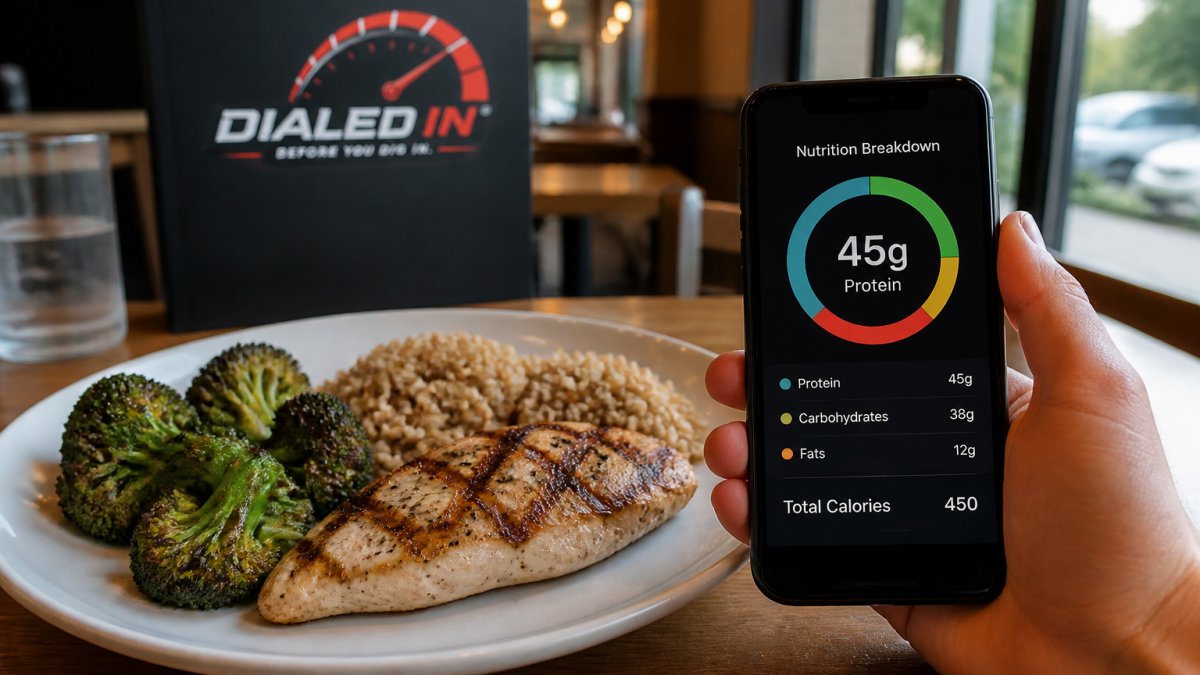
A traditional app requires scanning or searching for the dish, estimating portion size, adjusting for sauce or oil, logging it, and checking your target. Dialed In flips the process: point the camera at the menu, get a recommendation calculated to hit your protein target, and order with confidence.
Testing in real restaurants reveals practical limitations. Chain restaurants with standardized portions (like Chipotle or Panera) are easier to estimate accurately; independent restaurants with variable plating present challenges. A 6-ounce chicken breast might actually be 7 ounces elsewhere, creating 10-15% variance.
The apps that handle this best don't pretend precision. They show a range ("40-50g protein") rather than a fixed number, and they let users adjust based on what they actually received. This builds trust rather than frustration when the estimate doesn't match reality.
Dialed In: No-Logging AI Coaching for Any Menu
Dialed In provides real-time coaching before and during the meal rather than logging after the fact. Point the camera at a menu, get personalized recommendations aligned with your fitness goals, and order with confidence. No account creation, no manual logging.
The core differentiation is eliminating friction: traditional apps add steps to the restaurant decision-making process, while Dialed In removes them with instant recommendations based on your goals.
For busy professionals who eat out frequently, this is the critical distinction. Dialed In eliminates this by analyzing the menu and recommending options in real-time.
The app works on any menu: chain restaurants, independent establishments, food trucks. The AI analyzes the menu photo, identifies dishes, and ranks them by how well they align with the user's goals (fat loss, muscle building, maintenance). For someone targeting high protein, it surfaces protein-rich options first and explains why each fits.
Free vs. Paid: What You Actually Get
Most AI nutrition apps offer a limited free tier, then upsell to premium features. Understanding what's included in each tier is critical for deciding if the app is worth paying for.
Dialed In is a premium product designed for users who prioritize convenience and personalized coaching over cost. The value proposition is clear: eliminate logging friction and get AI-powered recommendations in exchange for a subscription.
The question isn't whether free is better than paid, but whether the features justify the price for your use case.
Common Mistakes When Using Nutrition Apps at Restaurants
Even the best AI nutrition app can't overcome user mistakes. These common pitfalls matter most.
Mistake 1: Trusting the estimate without context. A 650-calorie burger estimate could be 800+ with extra toppings the app can't see from a menu photo. Adjust estimates based on what you actually ordered.
Mistake 2: Assuming restaurant portions match the database. A "6-ounce chicken breast" might be 7 ounces elsewhere. Use the portion-size slider to adjust based on what you actually received.
Mistake 3: Logging after eating instead of before. Traditional tracking apps encourage post-meal logging, which doesn't change the decision.
Mistake 4: Ignoring confidence scores. If an app shows "medium confidence" on a restaurant estimate, that's a signal to adjust the numbers. Chain restaurants with standardized recipes are more reliable than independent establishments. Adjust your expectations accordingly.
Mistake 5: Not accounting for hidden ingredients. Restaurant dishes often contain oils, butters, and sauces not visible on the plate. A "grilled" item is often grilled in butter. Ask servers about preparation and adjust estimates upward if needed.
Mistake 6: Expecting precision where variance is normal. Restaurant food is inherently variable. Aiming for a 50-calorie margin of error is unrealistic. Focus on directional accuracy, getting within 10-15% of your target, rather than perfect precision.
The challenge with restaurant nutrition is that consistency is impossible. Every restaurant prepares dishes differently, portions vary, and hidden ingredients add unpredictable calories.
Dialed In eliminates the tracking friction entirely by analyzing menus and recommending high-protein options aligned with specific fitness goals before the order is placed. No account creation, no manual logging, no spreadsheets.
Claim your founder spot with Dialed In to start getting personalized menu recommendations that help hit your protein targets at any restaurant.
Frequently Asked Questions
Can AI food scanner apps accurately identify calories and macros in restaurant dishes?
AI food scanner apps estimate calories and macros by analyzing meal photos, but accuracy varies. Restaurant dishes present challenges because preparation methods, portion sizes, and ingredients aren't always visible. Most apps estimate within 10-20% of actual values for common meals, but sauces, oils, and mixed dishes can skew estimates higher or lower. Cross-checking estimates against restaurant nutritional data when available improves accuracy for hitting protein goals.
What makes a protein tracking app better than basic calorie counters?
Protein tracking apps let you set specific daily protein targets and monitor progress toward muscle-building or body recomposition goals. Basic calorie counters focus only on total energy intake. Apps that emphasize protein show you which meals align with your target, suggest high-protein swaps, and help you prioritize protein-rich options at restaurants. This specificity matters if your goal is gaining muscle or maintaining lean mass while losing fat.
Do I need an account to use AI nutrition apps for restaurant menus?
Most AI nutrition apps require account creation to save meal history and track progress over time. However, some newer tools like Dialed In eliminate account requirements entirely, delivering personalized recommendations instantly without onboarding. If you want meal tracking and long-term progress insights, account-based apps work better. If you prefer quick, one-time recommendations at the moment you're ordering, no-account options are faster.
How do AI nutrition apps handle dietary constraints alongside protein goals?
Leading AI nutrition apps let you specify dietary constraints (allergies, vegetarian, keto, gluten-free) alongside macro targets. The app then filters restaurant menu suggestions to show only compliant, high-protein options. This prevents recommendations that technically hit your protein goal but violate your dietary needs. Test the app's constraint logic with a restaurant menu you know well to confirm it excludes restricted items accurately.