 Listicle
High Protein Grocery List: 40 Foods That Work in 2026
Table of Contents
- How to Build a High Protein Grocery List That Fits Your Goal
- The High Protein Foods List: 40 Staples by Food Group
- Cheap High Protein Foods: Best Protein Per Dollar
- High Protein Foods for Weight Loss
- Your High Protein Meal Prep Grocery List for the Week
- Dietary Swaps, Storage, and Cutting Waste
- Frequently Asked Questions
Last Updated: October 16, 2026
How to Build a High Protein Grocery List That Fits Your Goal
A high protein grocery list works best when it starts with a number, not a food. Pick your daily protein target first, then buy foods that hit it without wrecking your budget.
Protein needs vary by body weight, activity level, and goal. According to the Dietary Guidelines for Americans, protein should make up a meaningful share of daily calories for most adults, though exact needs depend on individual factors.
Below, this high protein grocery list breaks down 40 staples by food group, ranks the cheapest sources per dollar, and maps a week of meals to one shopping trip.
Set Your Daily Protein Target First
The right daily target depends on your goal. A common starting point is roughly 0.7 to 1 gram of protein per pound of body weight for muscle gain, and slightly less for weight loss or maintenance.
For a 160-pound person building muscle, that means 110 to 160 grams per day, roughly 28 to 40 grams per meal across four meals. That number tells you how much chicken, yogurt, or tofu to buy.
A Quick Way to Sanity-Check Any Food Before It Hits Your Cart
A food earns a spot on a high protein grocery list when protein makes up a large share of its calories. Divide grams of protein by total calories, then multiply by 100: anything above 40% is a strong pick. Peanut butter has protein but also heavy fat, so it scores lower than chicken breast.
The High Protein Foods List: 40 Staples by Food Group
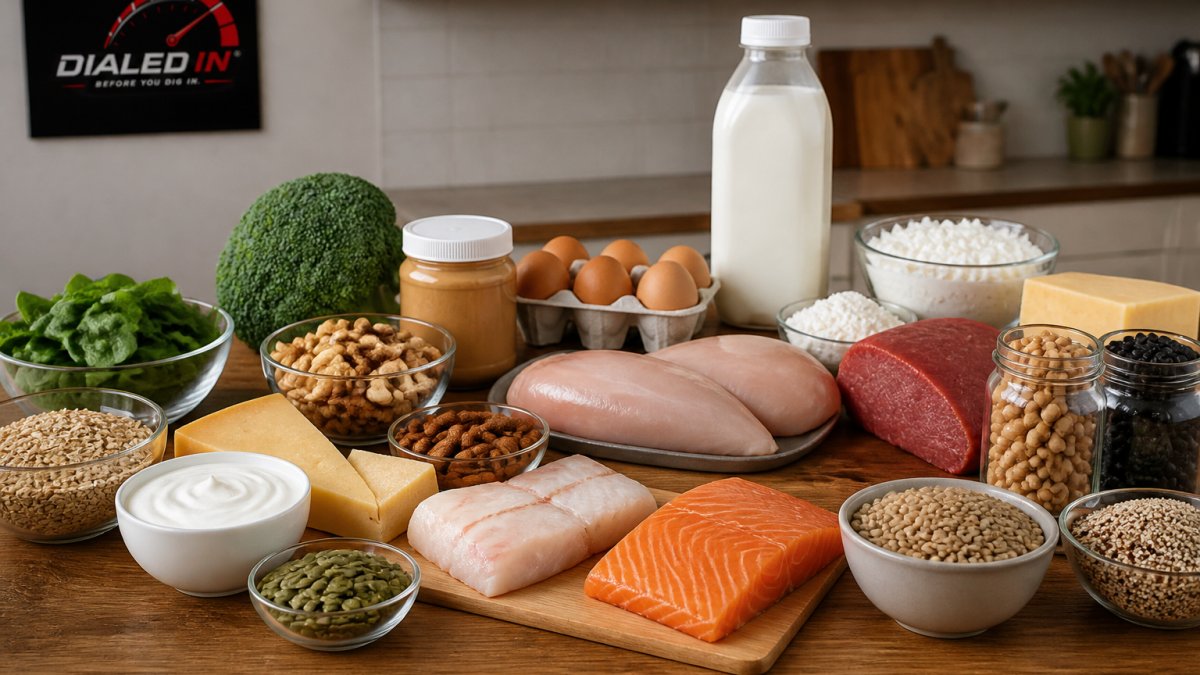
The 40 foods below cover every major food group, so a cart built from this list stays balanced. Each entry notes protein per serving, and later sections flag the cheapest options per gram.
Meat and Poultry
Chicken breast leads most lists: about 26 grams of protein per 3-ounce cooked serving with very little fat. Turkey breast, lean ground beef and turkey, pork tenderloin, and lean steak round out the group.
Buy family packs on sale and freeze in single-meal portions, that habit cuts cost per serving more than any coupon.
Fish and Seafood
Salmon, tuna, shrimp, and cod anchor this group. A 3-ounce serving of cooked salmon delivers roughly 22 grams of protein; shrimp packs about 20 grams per 3 ounces with almost no fat.
Frozen fillets cost less than fresh and keep for months. For a high protein meal prep grocery list, frozen seafood is often the smarter buy.
Eggs and Dairy
Eggs, Greek yogurt, and cottage cheese form the backbone of most high-protein diets. One large egg has about 6 grams of protein, a cup of plain Greek yogurt can exceed 20 grams, and cottage cheese delivers roughly 24 grams per cup.
Whey protein powder adds a fast 20 to 25 grams per scoop and blends into almost anything.
Plant-Based Proteins: Beans, Legumes, Tofu, and Grains
Tofu, tempeh, and edamame cover the soy options; lentils, black beans, and chickpeas deliver protein plus fiber; quinoa and hemp seeds fill out the grains. A cup of cooked lentils provides about 18 grams of protein, and a cup of edamame lands near 17 grams.
Plant proteins rarely qualify as complete protein on their own, meaning they lack one or more essential amino acids. Pairing beans with rice, or lentils with grains, solves that.
Cheap High Protein Foods: Best Protein Per Dollar
Most lists rank foods by protein content, but that is the wrong metric in the aisle. What matters is protein per dollar, how many grams you get per dollar spent. Two foods can both deliver 20 grams per serving, but if one costs three times as much, it belongs elsewhere in your cart.
Here is how the budget leaders stack up using typical national grocery prices, planning benchmarks, not fixed quotes, since prices vary by region, store, and season.
| Food | Protein Per Serving | Typical Price | Protein Per Dollar |
|---|---|---|---|
| Eggs (large, dozen) | 6g per egg | $3-$5 per dozen | ~18-24g per $1 |
| Dried lentils (1 lb bag) | 18g per cup cooked | $1.50-$3 per lb | ~25-35g per $1 |
| Canned tuna (5 oz can) | 20g per can | $1-$2 per can | ~10-20g per $1 |
| Chicken thighs (bone-in) | 24g per 3 oz | $1.50-$3 per lb | ~20-30g per $1 |
| Chicken breast (boneless) | 26g per 3 oz | $3-$6 per lb | ~12-20g per $1 |
| Plain Greek yogurt (32 oz tub) | 20g per cup | $5-$8 per tub | ~10-16g per $1 |
| Cottage cheese (16 oz) | 24g per cup | $3-$5 per container | ~12-18g per $1 |
| Dried black beans (1 lb) | 15g per cup cooked | $1.50-$3 per lb | ~20-30g per $1 |
| Whey protein (2 lb tub) | 20-25g per scoop | $25-$40 per tub | ~15-25g per $1 |
| Tofu (14 oz block) | 10g per 3 oz | $2-$4 per block | ~10-18g per $1 |
The Four Budget Champions
Eggs, dried lentils, dried beans, and chicken thighs consistently win on protein per dollar. A dozen eggs at $4 delivers roughly 72 grams of protein, about 18 grams per dollar.
The catch is preparation time. Dried beans and lentils need soaking and cooking, while eggs and canned tuna are ready in minutes. If your time is worth more than your grocery budget, canned beans and rotisserie chicken are reasonable middle-ground buys.
Where the Money Leaks
Protein powder, pre-made shakes, and protein bars are the most expensive way to hit a target. A single protein bar often costs $2-$3 for 15-20 grams. The same money buys a dozen eggs.
Buying fresh salmon, grass-fed beef, and organic free-range chicken adds cost without adding protein. The protein content is nearly identical to conventional or frozen versions.
How to Build a Budget Cart
Start with the cheapest sources that fit your diet, then fill gaps with convenience items. A practical weekly split for one person:
- 2 dozen eggs (~$6-$10)
- 2 lb dried lentils or beans (~$3-$6)
- 3 lb chicken thighs (~$5-$9)
That cart costs roughly $26-$46 and delivers well over 700 grams of protein for the week, enough for a 160-pound person eating 100-150 grams daily, versus $80-$120 for the same protein from bars and shakes.
Prices shift by region and season, so check local listings before a big stock-up. Tools like GroceryChop's price comparison search let shoppers compare costs across chains before committing.
High Protein Foods for Weight Loss
For weight loss, the goal is high protein foods that also keep calories and fat low. Chicken breast, shrimp, egg whites, plain Greek yogurt, and white fish fit best: protein satisfies hunger while calories stay modest.
Protein supports satiety, the feeling of fullness after eating. That is why a high protein diet often makes calorie control easier without constant hunger. Fiber-rich options like lentils and black beans add to that effect.
Your High Protein Meal Prep Grocery List for the Week
A list of foods is not a plan. This section turns the 40 staples above into a single shoppable trip with quantities, a day-by-day meal map, storage guidance, and swaps. Quantities suit one person for seven days, assuming four meals a day at roughly 30 grams of protein each, about 120 grams daily.
Quantities for One Person, One Week
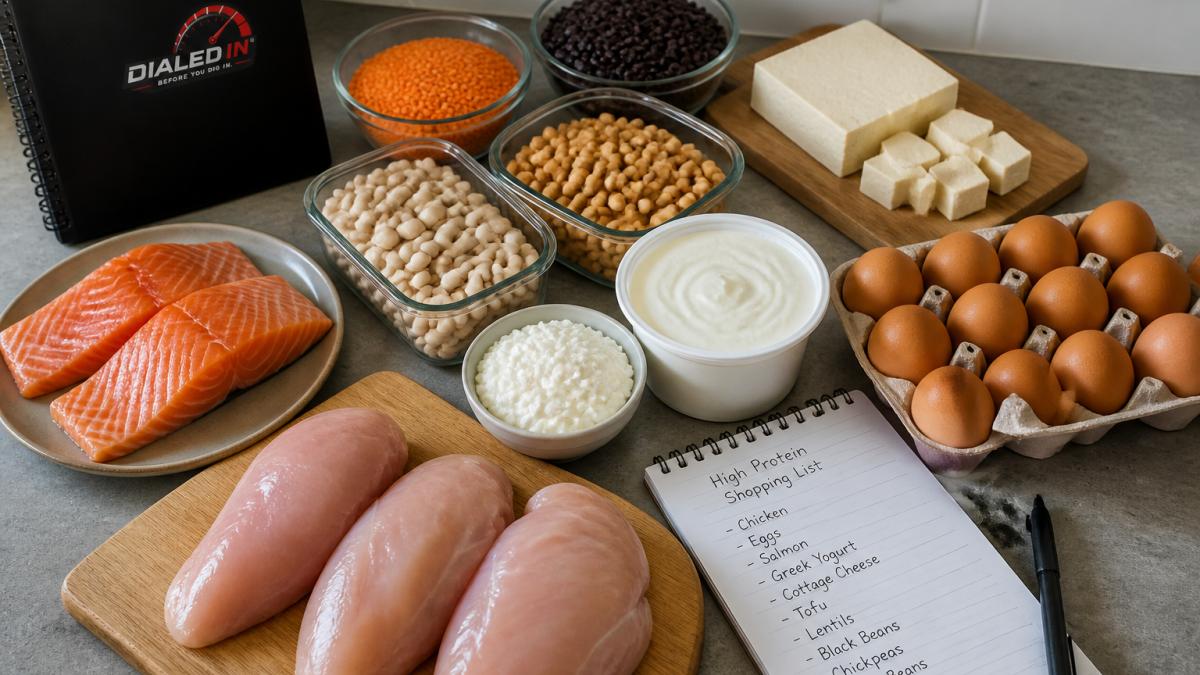
- 3 lb chicken breast or thighs
- 2 dozen eggs
- 1 large tub plain Greek yogurt (32 oz)
This cart delivers roughly 800-900 grams of protein total, enough for a 160-pound person eating 110-150 grams per day, with a buffer for larger appetites or higher activity.
A 7-Day Meal Map That Uses Every Item
| Day | Breakfast | Lunch | Dinner | Snack |
|---|---|---|---|---|
| Mon | 3 eggs + spinach | Tuna over rice | Chicken + lentils | Greek yogurt + hemp seeds |
| Tue | Greek yogurt + hemp | Lentil soup | Salmon + quinoa | Cottage cheese |
| Wed | 3 eggs + spinach | Leftover chicken | Tofu stir-fry + edamame | Protein shake |
| Thu | Greek yogurt + hemp | Tuna + beans | Lean beef + vegetables | Edamame |
| Fri | 3 eggs + spinach | Lentil bowl | Salmon + rice | Cottage cheese |
| Sat | Protein shake + eggs | Leftover tofu | Chicken + quinoa | Greek yogurt |
| Sun | Greek yogurt + hemp | Tuna + lentils | Lean beef + vegetables | Edamame |
Each day lands near 120 grams of protein without logging a single calorie. The plan reuses leftovers deliberately: Monday's chicken becomes Wednesday's lunch, Friday's salmon becomes Saturday's dinner.
Storage and Waste Reduction
How you store this cart determines whether it lasts the week or spoils by Wednesday.
- Freeze immediately: Portion chicken, beef, and fish into meal-sized bags the day you bring them home. Frozen meat keeps 3-6 months; fresh only lasts 1-2 days in the fridge.
- Cook once, eat three times: Batch-cook a pot of lentils and a tray of chicken on Sunday. Cooked lentils and beans keep about 5 days refrigerated. Cooked chicken keeps 3-4 days.
- Eggs: Refrigerated eggs last 3-5 weeks past the purchase date. They are the most forgiving item on the list.
The USDA's food safety guidance recommends refrigerating perishables within two hours of purchase to reduce waste and spoilage risk.
Dietary Swaps for the Same Plan
Every item on this list has a substitute that keeps the protein target intact.
- Vegetarian: Replace chicken, beef, and fish with extra tofu, tempeh, and eggs. Double the lentils and add a second block of tofu. Protein target stays reachable.
- Vegan: Drop eggs and dairy entirely. Replace Greek yogurt with a soy-based yogurt with added protein, swap cottage cheese for extra edamame, and lean on lentils, beans, and tofu. Add a plant protein powder to close the gap.
- Dairy-free: Use plant-based yogurt and skip cottage cheese. Eggs and meat stay if you eat them.
When eating out instead of cooking, point a camera at the menu and let Dialed In's AI food coach suggest the highest-protein dish on the page.
Dietary Swaps, Storage, and Cutting Waste
The USDA's food safety guidance recommends refrigerating perishables within two hours of purchase to reduce waste and spoilage risk.
Frequently Asked Questions
What should I put on a high-protein grocery list?
Start with a protein anchor for each meal: chicken breast, lean ground beef, eggs, Greek yogurt, cottage cheese, canned tuna, salmon, tofu, lentils, and beans. Add supporting items like quinoa, edamame, spinach, and hemp seeds. Aim for roughly 1.6 grams of protein per kilogram of body weight daily, and split it across three to four meals so each sitting lands near 30 grams. A written high protein grocery list keeps you from improvising at the store.
What are some affordable high-protein foods?
Eggs, canned tuna, dried lentils, black beans, chicken thighs, cottage cheese, and plain Greek yogurt deliver the most protein per dollar in most stores. Dried beans and lentils cost far less per serving than pre-cooked versions, and frozen fish fillets often undercut fresh. Check unit prices on the shelf tag rather than package price, and compare chains with a free tool like GroceryChop before you commit to a store.
What food items have the highest protein?
Per 100 grams cooked, chicken breast, turkey breast, lean ground beef, tuna, and shrimp all land above 25 grams of protein. Greek yogurt and cottage cheese sit in the teens to low twenties, while tofu, tempeh, lentils, and edamame cover the plant side at 9 to 19 grams. Eggs provide about 6 grams each. Animal sources are complete proteins; plant sources need pairing across the day to cover all essential amino acids.
How can I build a high-protein meal from grocery store foods?
Pick one protein anchor, add a second smaller source, then fill the rest of the plate with vegetables and a measured starch. A rotisserie chicken, a bag of frozen edamame, and a microwave rice cup gets you near 45 grams of protein in under ten minutes. If you eat out often, point your camera at the menu and let Dialed In flag goal-aligned dishes before you order.
Is it normal to have diarrhea on a high protein diet?
It can happen when you jump from low to very high protein quickly, especially if fiber and water intake drop at the same time. Increase protein gradually over one to two weeks, keep vegetables, beans, and whole grains in the cart, and drink water throughout the day. If symptoms persist beyond a week or come with pain, see a doctor rather than adjusting your diet further.