 How-to
7 Instant Nutrition Habits for a Healthier Daily Routine
Last Updated: November 20, 2026
Quick Summary
Integrating instant nutrition advice into daily routines means getting guidance at the moment you decide, not a report card hours later. Build your routine on three anchors: a morning reset, a midday check, and an evening close. A decision made in five seconds beats a spreadsheet filled out for weeks.
- Drink water and pick one protein for breakfast before anything else each morning.
- Pause before ordering or grabbing food and ask what your body needs now.
- Note one choice that worked and one to adjust tomorrow at day's end.
- Check protein, produce, and portion in that order to guide most meals.
- Consult a registered dietitian when managing a chronic condition, pregnancy, or food-medication interactions.
Table of Contents
- Why Instant Nutrition Advice Beats Another Tracking App
- Build a Daily Routine for Healthy Eating in Three Anchors
- Healthy Eating Tips That Work in Real Time
- Healthy Eating on the Go: Restaurants, Drive-Thrus, and Vending Machines
- Healthy Food Choices Without Tracking: A Decision Framework
- Personalize Instant Nutrition Advice for Your Goals and Dietary Needs
- Troubleshoot Your Routine When It Stops Working
- Claim Your Founder Spot and Start Your First Instant Nutrition Decision
- Frequently Asked Questions
Why Instant Nutrition Advice Beats Another Tracking App
Most nutrition apps ask you to log everything you eat. Then they judge you for it. That backward loop is why so many people quit.
A common mistake is treating nutrition like accounting. For a practical walkthrough, see this how-to guide to getting real-time nutrition advice. You eat, you record, you reconcile. But food choices happen fast, in real kitchens and busy restaurants, and manual logging rarely survives a hectic Tuesday.
Build a Daily Routine for Healthy Eating in Three Anchors
A daily routine for healthy eating does not need a perfect meal plan. It needs three reliable anchors: a morning reset, a midday check, and an evening close. Anchor-based routines survive busy weeks because they attach to moments you already have, not to willpower you may not.
Here is how the anchors work:
- Morning reset: Drink water and pick one protein for breakfast before anything else.
- Midday check: Pause before ordering or grabbing food and ask what your body needs now.
- Evening close: Note one choice that worked and one to adjust tomorrow.
Three anchors. That is the whole system. Small changes compound, and the routine stays light enough to keep.
The whole system is three anchors attached to moments you already have.
| Anchor | What to do | When |
|---|---|---|
| Morning reset | Drink water and pick one protein for breakfast | Before anything else |
| Midday check | Pause and ask what your body needs now | Before ordering or grabbing food |
| Evening close | Note one choice that worked and one to adjust | End of the day |
Healthy Eating Tips That Work in Real Time
Real-time healthy eating tips share one trait: they arrive before the decision, not after. Waiting until the end of the day to review your food choices is like checking the weather after the picnic. Useful information, wrong timing.
Try these in-the-moment habits:
- Scan the plate before the first bite and spot the protein, vegetable, and starch.
- Reach for water first when a craving hits, then decide.
- Pick the grilled option over the fried one when both exist.
- Add a vegetable to whatever you already planned to eat.
- Stop eating when energy dips, not when the plate is empty.
None of these require an app or a log. They require a prompt at the right second. That is exactly where instant nutrition earns its keep, and a real-time decision guide can help you act on one of these choices right now.
Healthy Eating on the Go: Restaurants, Drive-Thrus, and Vending Machines
Healthy eating on the go falls apart for one reason: menus are built to upsell, not to inform. A drive-thru combo, a restaurant special, or a vending machine row all push the easiest choice, not the best one.
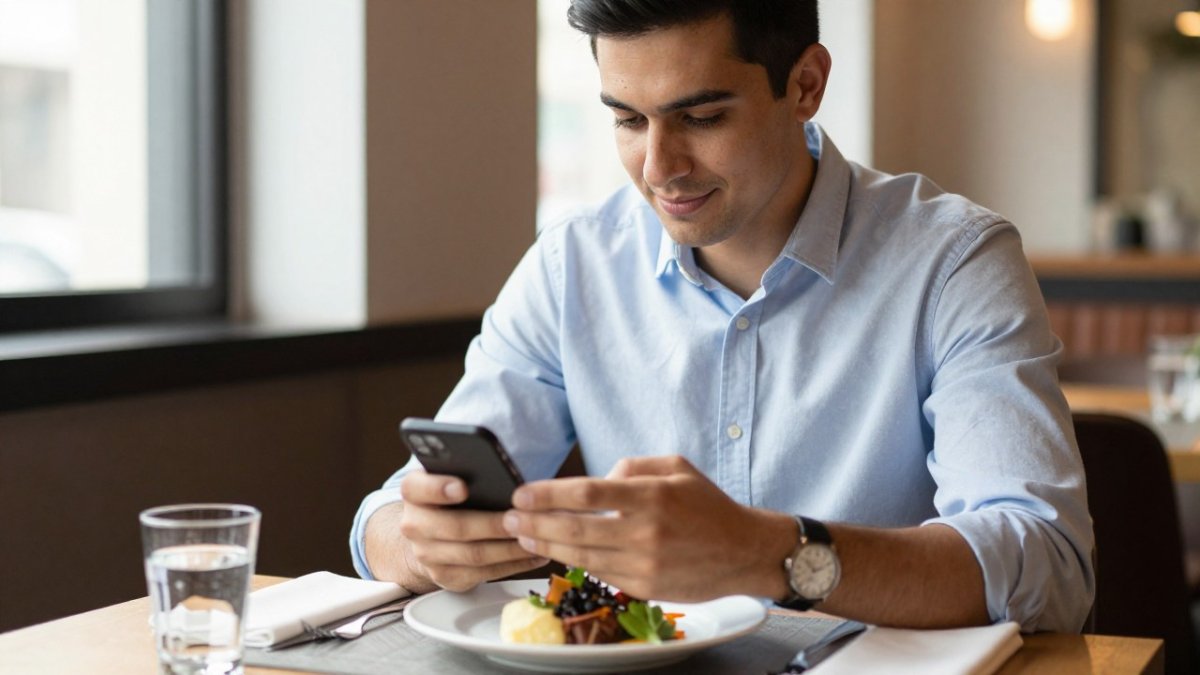
Restaurants: order in a fixed sequence
Using the same three-step order every time can help the decision feel made before you open the menu:
- Pick the protein first. Grilled chicken, fish, steak, eggs, beans, or tofu. Say it out loud to yourself before you read the sides.
- Pick one vegetable side. If the entree already includes vegetables, skip this step rather than doubling up on starch.
- Put sauces and dressings on the side. You keep the flavor and control the amount; a cup of dressing can carry more calories than the salad it sits on.
When the menu is unfamiliar, ask the server two questions: what is the leanest protein on the menu, and which side is a vegetable rather than a starch. Most kitchens answer both without hesitation.
Drive-thrus: break the combo
The combo is priced to move fries and a sugary drink, not to feed you well. Order items individually instead:
- Choose a grilled or roasted protein sandwich over a fried one when both exist.
- Swap fries for a side salad, fruit cup, or plain baked potato where offered.
- Order water, unsweetened tea, or a diet drink instead of the regular soda.
- Skip the upsized size; the price difference is small and the portion difference is not.
Watch out: "grilled" chicken sandwiches at some chains are still served on a buttered bun with a mayonnaise-based sauce, so ask for the sauce on the side and check whether the bun is toasted with butter.
Vending machines and convenience stores
Vending rows are arranged to put chips and candy at eye level. Look at the bottom row and the top row first:
- Nuts, seeds, or a protein bar with at least 10 grams of protein beat chips or candy.
- Plain or lightly salted popcorn beats a candy bar on volume and fiber.
- At a convenience store, a single-serve Greek yogurt, a hard-boiled egg, or a cheese stick plus fruit is a better anchor than a pastry.
- Skip the energy drink; water or a plain coffee is the safer default.
When the menu is unfamiliar
Point a camera at it. Dialed In reads any menu, meal, or fridge shelf and suggests a pick that fits your goal, with no logging required. For a head start, these healthy takeout orders show what a good call looks like in practice.
The point of these rules is not to make every meal perfect. It is to make the default choice a decent one, so a busy day does not turn into a string of decisions you regret.
Healthy Food Choices Without Tracking: A Decision Framework
Healthy food choices without tracking rest on a simple decision framework: protein, produce, portion. Check those three boxes in order and most meals land close to where you want them, no spreadsheet required.
Use this quick sequence:
- Protein: Is there a clear protein source? If not, add one.
- Produce: Is there a vegetable or fruit? If not, add one.
- Portion: Would a smaller plate still satisfy you? If yes, size down.
That framework handles home cooking and restaurant meals alike. It also explains why tracking apps feel like extra work: they measure after the fact, while a framework guides the choice itself. If you want the deeper version of this approach, this guide on tracking macros without logging walks through it step by step.
Personalize Instant Nutrition Advice for Your Goals and Dietary Needs
Generic advice fails specific people. A high school athlete building muscle, a busy professional holding weight, and someone managing a dietary restriction need different answers to the same menu. Personalization is what turns instant nutrition from a slogan into something usable.
Match the guidance to the goal
- Fat loss: prioritize protein and volume, keep portions moderate, and build meals around vegetables and lean protein so hunger stays manageable.
- Muscle building: anchor every meal with protein and eat on a schedule rather than waiting until you are starving.
- Weight maintenance: keep the routine steady and avoid drastic swings; consistency matters more than any single meal.
- General health: aim for variety across food groups rather than optimizing any one nutrient.
Adjust for dietary needs and restrictions
Restrictions are not an afterthought; they are the first filter. Flag them before any other rule applies:
- Food allergies: treat the allergen as a hard stop. Read labels on packaged foods and ask about ingredients at restaurants; cross-contact in kitchens is common.
- Cultural and religious preferences: build the plan around the foods you already eat. A routine that ignores your usual cuisine will not survive a week.
- Budget: frozen vegetables, canned beans, eggs, oats, and plain yogurt deliver nutrition at low cost. A tight budget is a constraint to design around, not a reason to abandon the routine.
- Diabetes and blood-sugar concerns: pair carbohydrates with protein, fat, or fiber to blunt spikes, and follow the guidance of your care team rather than a generic app.
- Kidney, heart, or other clinical conditions: these often require specific limits on sodium, potassium, protein, or fluid that generic advice can get wrong.
Know when to bring in a professional
Instant advice is a decision aid, not a diagnosis. Consult a registered dietitian or your clinician when you are managing a chronic condition, taking medications that interact with food, pregnant or breastfeeding, feeding a child with a restriction, or recovering from an eating disorder. A registered dietitian can translate general rules into a plan built around your labs, medications, and history.
Check the tool before you trust it
Not every app that offers nutrition advice is reliable. Before you rely on one, check who wrote the guidance, whether it cites recognized public health sources, whether it asks about your restrictions, and how it stores your data.
A common mistake is copying someone else's plan. What works for a training partner may not fit your schedule, budget, or kitchen. If accuracy is a concern, this breakdown of automated nutrition coaching covers what these tools can and cannot do.
Troubleshoot Your Routine When It Stops Working
Every routine stalls eventually. The fix is rarely a stricter diet. It is usually a broken anchor, a decision made on autopilot, or a goal that drifted without anyone noticing. Troubleshoot the system before you blame yourself.
Work through this checklist:
- Did one anchor quietly disappear from the day?
- Are meals skipping protein and leaving you hungry?
- Has the goal changed without the routine catching up?
- Are you eating out more than the routine assumes?
- Is hydration slipping, making cravings feel like hunger?
Pick the one broken item and repair it for a week. One fix at a time beats an overhaul. Watch out: rebuilding the entire routine after a single bad day is the fastest way to abandon it. Restart the anchor, not the whole plan.
Claim Your Founder Spot and Start Your First Instant Nutrition Decision
The gap between knowing what to eat and actually choosing it is where most routines die. Closing that gap takes a prompt at the right moment, not more willpower.
Most people do not need another tracker. They need a coach standing beside them at the menu. Dialed In provides real-time AI food decision coaching that works on any menu, meal, or refrigerator item, with personalized recommendations built around your fitness goals. There is no account to create and no logging to keep up with.
Frequently Asked Questions
How can I make healthier food choices throughout the day without logging every meal?
Build three anchors: a protein-forward breakfast, a planned lunch, and a vegetable-first dinner. Between them, use a quick decision rule at each meal: pick a protein, add a vegetable or fruit, and choose a whole-grain or healthy-fat side. Instant nutrition advice helps at the moment of choice, so you do not need to reconstruct your day in a food log later.
How long does it take to build a healthy eating habit?
Most people need two to three months of consistent repetition before a new eating routine feels automatic. Start with one anchor meal, repeat it for two weeks, then add a second. Keep the change small enough that a busy day does not break it. Instant nutrition advice shortens the learning curve because you get feedback at the decision point instead of reviewing mistakes after the fact.
Can instant nutrition advice help with muscle building and protein goals?
Yes. Point your camera at a menu or plate and ask for the protein estimate and a higher-protein swap. For muscle building, aim for a palm-sized protein source at each meal and a protein snack after training.
Is instant nutrition advice private if I am scanning food with my camera?
Privacy depends on the app. Before you scan, check whether images are stored, who can access them, and whether you can delete them. Dialed In is designed for real-time decisions with no account or manual logging required. Read the privacy policy and look for clear language on image retention and deletion.