 Ultimate guide
7 Psychological Benefits of Automated Nutrition Coaching
Last Updated: November 9, 2026
Quick Summary
Automated nutrition coaching is a software-driven approach that tracks, interprets and responds to what you eat, replacing or supplementing a human coach. Its psychological appeal is that it removes the constant weighing of options, the logging burden and the guesswork at the moment of decision.
- Automated coaching shifts the question from "What have I eaten today?" to "What is the best option right now?
- Food is a heavy source of decision fatigue, since people face dozens of small food choices each day.
- Research directly measuring how automated food tools affect emotional eating remains sparse, so that benefit is a hypothesis.
- Self-efficacy built on a tool can be fragile if the tool alone supplies the sense of mastery.
- Automated tools do not replace a registered dietitian or clinician for people with eating disorders or complex needs.
Table of Contents
- What Automated Nutrition Coaching Actually Does for Your Mind
- Reducing Food Decision Fatigue at Every Meal
- Lower Food Anxiety and Less Emotional Eating
- Building Self-Efficacy Through Small, Measurable Wins
- AI Nutrition App Benefits That Affect Long-Term Adherence
- Risks, Privacy Concerns and Where Automated Coaching Falls Short
- Deciding Whether Automated Coaching Fits Your Goals
- Frequently Asked Questions
What Automated Nutrition Coaching Actually Does for Your Mind
Automated nutrition coaching is a software-driven approach that replaces or supplements a human coach with algorithms that track, interpret and respond to what you eat. Dialed In is a real-time AI food decision coach designed to analyze menus, pantry items and refrigerator ingredients, then recommend choices aligned with a specific goal such as fat loss, muscle gain or weight maintenance. The psychological interest lies in what that automation removes: the constant weighing of options, the logging burden and the guesswork at the point of decision.
Most people approach nutrition with a mental ledger of rules, numbers and guilt. Automated guidance shifts that load from memory to the moment, so the question changes from "What have I eaten today?" to "What is the best option in front of me right now?"
Reducing Food Decision Fatigue at Every Meal
Decision fatigue describes the decline in decision quality that follows a long run of choices. Food is a particularly heavy source of it, because people face dozens of small food decisions each day, from breakfast to a late snack, and many of them happen under time pressure. Choosing at a restaurant counter after a long workday is a common example of where judgment degrades.
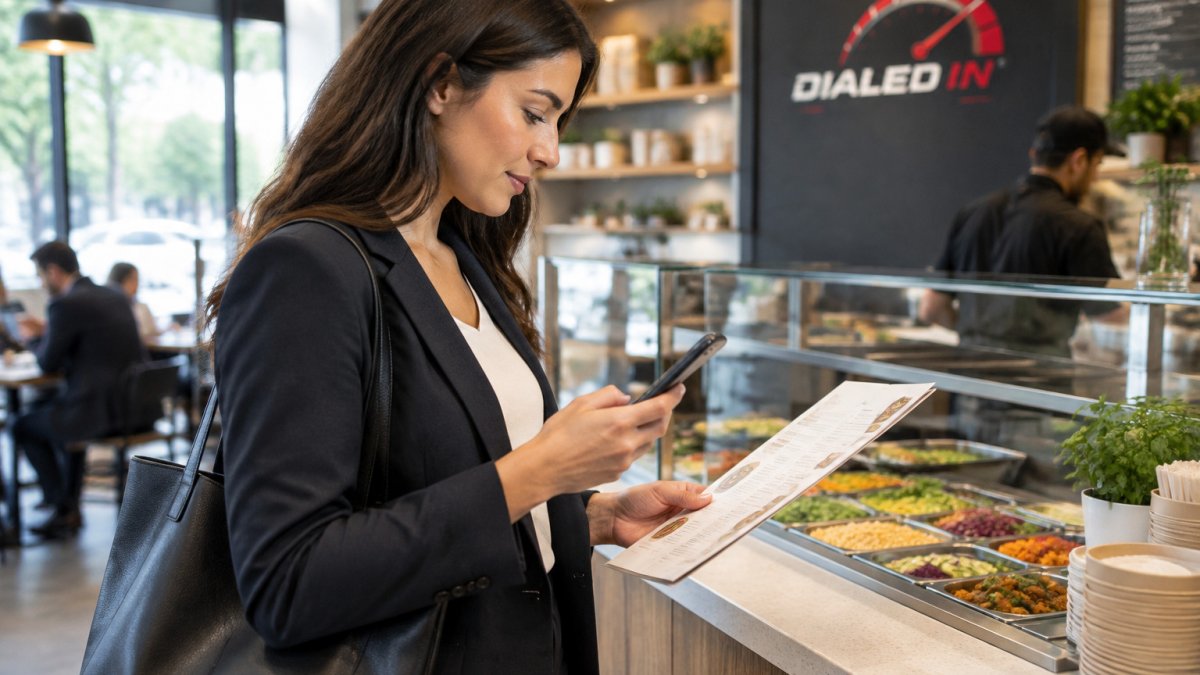
Automated coaching targets that moment directly. Instead of rebuilding a plan from scratch while reading a menu, a user receives a recommendation tied to their goal. The mental effort drops, and the decision takes seconds. For readers who want a practical framework for this, the guide on How to Use AI to Prevent Overeating at Home explains how the same principle applies in a kitchen, and What Should I Eat: A Real-Time Decision Guide walks through choosing in the moment.
The article ties food decision fatigue to specific pressure points, and the table below summarises them so readers can see where automated coaching helps.
| Source of fatigue | Why it happens | How automated coaching responds |
|---|---|---|
| Many daily food choices | Dozens of small decisions each day | Recommendation delivered in seconds |
| Time pressure | Choices made under deadline | Goal-linked suggestion without rebuilding a plan |
| Restaurant menus | Judgment degrades after a long workday | Choice matched to the user's goal at the counter |
| Long decision runs | Decision quality declines with volume | Less mental effort per meal |
Lower Food Anxiety and Less Emotional Eating
Food anxiety often grows from uncertainty: not knowing whether a meal fits a goal, or fearing a wrong choice will derail progress. Rigid diets amplify this because any deviation feels like failure. Automated coaching can reduce that uncertainty by replacing a vague sense of doubt with a specific, goal-linked suggestion.
The link to emotional eating is indirect but plausible. When people feel anxious about food, they may swing between restriction and overeating. A tool that provides steady, non-judgmental guidance may help some users avoid that cycle. The evidence here is limited, however. Research directly measuring how automated food tools affect emotional eating remains sparse, so readers should treat this benefit as a reasonable hypothesis rather than a proven result.
Building Self-Efficacy Through Small, Measurable Wins
Self-efficacy, a person's belief in their ability to carry out a task, is a central concept in behavioral psychology and one of the more reliable predictors of sustained behavior change. Psychologist Albert Bandura's framework identifies four sources of self-efficacy: mastery experiences, vicarious experience, verbal persuasion, and physiological or emotional states.
A traditional plan asks a user to succeed at an abstract, delayed task: hit a weekly average, stay under a number, follow a meal plan for seven days. Success is hard to feel in the moment, and failure is easy to perceive.
There is a boundary worth naming. Self-efficacy built on a tool can be fragile if the tool is the only thing supplying the mastery experience. A user who only feels capable while the app is open has built confidence in the app, not in themselves. Readers who want to test this can deliberately make one decision a day without opening the tool and notice whether the judgment holds.
Watch out: self-efficacy claims are easy to overstate. Most studies of digital nutrition tools measure engagement, weight, or dietary intake, not validated self-efficacy scales, so treat the mechanism as well-grounded theory rather than a proven outcome of any specific product. The practical test is behavioral: are you making goal-aligned choices without the tool more often after a month than you were before?
AI Nutrition App Benefits That Affect Long-Term Adherence
Adherence, whether people keep using a tool or plan over months, is where most nutrition approaches fail, and it is also where the psychological case for automation is strongest and least examined. The more useful question is which specific psychological mechanisms automation changes, and how strong the evidence for each one actually is.
Automated tools can reduce friction by removing calorie counting and spreadsheets, which are commonly cited reasons people abandon nutrition apps. They can also reduce the decision load of rebuilding a plan while reading a menu, and they respond at the moment of decision.
Those mechanisms are plausible, but the evidence quality varies, and readers deserve the distinction. Engagement metrics, sessions per week, days logged, retention at 30 or 90 days, are widely reported by app makers and are not the same as psychological or health outcomes. Peer-reviewed studies of digital nutrition interventions more often measure dietary intake, weight, or program completion than motivation, autonomy, or perceived support.
There is also a less discussed side of adherence: automation can keep people engaged for reasons that are not psychologically healthy. Streaks, badges, and daily prompts are engagement mechanics, and they can produce continued use driven by loss aversion or guilt rather than by genuine motivation. A user who opens the app to avoid breaking a streak is adhering, but not in a way that builds autonomy. The same feature that reduces friction can, if poorly calibrated, create pressure.
Watch out: notification fatigue is a real adherence risk, not just an annoyance. Users who receive frequent prompts often mute them, and once notifications are off, the tool's main advantage, guidance at the moment of decision, disappears. A practical check is to review your notification settings after two weeks and ask whether each prompt still helps you decide, or whether you are dismissing it on reflex.
For readers weighing whether a tool will hold their attention, the mechanics matter as much as the marketing. The explanation of AI Food Scanner Accuracy Explained: How It Works covers how recognition works, which bears directly on whether users trust the output enough to keep relying on it, and AI Food Tracking Privacy Explained covers the data questions that affect willingness to engage over time.
Risks, Privacy Concerns and Where Automated Coaching Falls Short
Automated coaching carries real limits that a balanced assessment must address. The first is accuracy: any system that estimates food from images can misjudge portions, ingredients and hidden fats. Users who trust recommendations uncritically may build false confidence. The second is privacy. Pointing a camera at food regularly means the app collects images and potentially location and usage data, so users should review how a provider stores and uses that information. AI Food Tracking Privacy Explained addresses these data questions in more detail.
There are also psychological risks. Constant reliance on an app for every food choice may weaken a person's own judgment over time, and some users may feel anxious when the tool is unavailable. Automated tools do not replace a registered dietitian or clinician for people with eating disorders, medical conditions or complex nutritional needs. Anyone with a history of disordered eating should involve a qualified professional before adopting a rule-based or metric-driven tool.
Deciding Whether Automated Coaching Fits Your Goals
The right choice depends on what you need. If your main barrier is the effort of logging and the paralysis of menu decisions, automated guidance may be worth considering. If you need detailed tracking of micronutrients, medical nutrition therapy or accountability from a human who knows your history, a dietitian or coach is the better fit, and an app can complement rather than replace that relationship.
Before committing, assess three things: whether the tool's recommendations match your goal, whether you can explain its privacy practices in your own words, and whether you still feel capable of making food decisions without it. Readers comparing options can look at AI Nutrition Coach vs Calorie Tracker: Key Differences to see how these approaches differ in structure and in the kind of judgment they ask you to make.
Frequently Asked Questions
Can I use AI as a nutritionist?
AI tools can give fast, goal-based food guidance, such as flagging meals that are high in protein or calories. They do not replace a registered dietitian, who can assess medical conditions, allergies, medications and eating disorders. Use AI for everyday decisions and involve a licensed professional when health conditions or clinical goals are involved. Check whether the tool clearly states its limits and how it handles your data before relying on it for regular guidance.
Does automated nutrition tracking improve long-term dietary adherence?
The evidence is still limited. Automation can reduce the effort of logging and decision-making, which many people cite as the reason they quit. However, controlled long-term studies specific to AI nutrition coaching are scarce, so results vary by user. Adherence tends to depend more on whether the plan fits your schedule, food preferences and goals than on the tool itself. Track whether you are still using the tool after eight to twelve weeks as a practical measure of fit.
Can AI-powered nutrition apps help with intuitive eating?
They can, but the fit is not automatic. Intuitive eating focuses on hunger and fullness cues rather than external rules. A coaching tool that gives strict numeric targets may work against that approach. Apps that offer flexible guidance, such as suggesting a balanced option rather than an exact calorie count, are more compatible. If you are working on disordered eating patterns, consult a clinician before using any app that frames food in numbers.
How does real-time AI feedback influence eating behaviors?
Immediate feedback at the moment of choice can shift behavior by making the trade-offs of a meal visible before you order or eat. This timing matters because many food decisions happen quickly and without planning. The effect on lasting habits is not well established, and some people may become overly reliant on the prompts. Use feedback as a prompt to think about your choice, and keep an eye on whether you feel more confident or more anxious over time.