 Ultimate guide
The Beginner's Guide to Natural Muscle Building Nutrition
Last Updated: November 18, 2026
Quick Summary
Muscle building nutrition means eating enough calories, protein, carbohydrates, and fats to support resistance training and recovery, and it works best when a beginner sets simple targets instead of chasing perfection. Start by multiplying your body weight in pounds by 16 to 18 for daily calories, then anchor every meal with a palm-sized portion of protein. Hold that plan for two to three weeks and adjust by about 200 calories based on the scale and your training performance.
- Estimate daily calories for muscle gain by multiplying body weight in pounds by 16 to 18.
- Target about 0.7 to 1 gram of protein per pound of body weight each day.
- Aim for a weekly weight gain of about half a pound to one pound.
- Hold each calorie change for at least two weeks before judging whether it worked.
- Track only body weight trend, training performance, waist measurement, and adherence for the first month.
Table of Contents
- Muscle Building Nutrition Basics for Beginners
- How Many Calories You Need to Build Muscle
- High-Protein Foods for Muscle Building
- How to Hit Protein Goals Daily Without Tracking
- A 7-Day Meal Plan for Muscle Gain
- Your 30-Day Muscle Building Diet Roadmap
- Common Nutrition Mistakes That Stall Beginner Gains
- Start Making Smarter Food Decisions With Dialed In
- Frequently Asked Questions
Muscle Building Nutrition Basics for Beginners
The core idea is energy balance. Muscle is metabolically expensive tissue, and the body will not build it in a calorie deficit large enough to strip away recovery resources.
Three numbers matter most at the start:
- Calories: a modest surplus above maintenance, not a free-for-all bulk.
- Protein: a consistent daily total, spread across meals.
- Carbohydrates: enough to fuel training sessions and refill glycogen.
Everything else, including meal timing, supplements, and micronutrient detail, is refinement.
The mistake nearly every beginner makes is treating nutrition as a math problem to solve once. It is a feedback loop: eat, train, measure, adjust.
How Many Calories You Need to Build Muscle
Start with body weight in pounds multiplied by 16 to 18 to estimate daily calories for muscle gain, then hold that number steady for two to three weeks before changing anything. A 160-pound beginner lands between roughly 2,560 and 2,880 calories per day. That range accounts for training, daily movement, and the small surplus needed to add lean mass without excessive fat gain.
The math is a starting point, not a verdict. Two people at identical body weight can differ substantially in calorie needs based on activity, training frequency, and genetics.
If the scale does not move after three weeks, add roughly 200 calories. If weight climbs faster than a pound per week with visible fat gain, trim 200.
Watch out: eating in a large surplus "to be safe" is the most common beginner error.
Worked examples for different body sizes and activity levels
The multiplier is a range because activity level shifts where you land inside it. Use the low end for a desk job and three training days a week; use the high end if you are on your feet all day or train five or more days. Here is how the formula plays out across common beginner profiles:
| Body weight | Activity and training | Multiplier | Daily calorie target |
|---|---|---|---|
| 130 lb | Desk job, 3 training days | 16 | about 2,080 |
| 130 lb | On feet daily, 5 training days | 18 | about 2,340 |
| 160 lb | Desk job, 3 training days | 16 | about 2,560 |
| 160 lb | On feet daily, 5 training days | 18 | about 2,880 |
| 190 lb | Desk job, 3 training days | 16 | about 3,040 |
| 190 lb | On feet daily, 5 training days | 18 | about 3,420 |
| 220 lb | Desk job, 3 training days | 16 | about 3,520 |
| 220 lb | On feet daily, 5 training days | 18 | about 3,960 |
These are starting estimates, not prescriptions. A 220-pound beginner carrying more body fat may find the high end overshoots; start low and let the scale trend guide you. A 130-pound beginner who struggles to gain may need the high end even with a desk job.
Turning calories into macros
Once you have a calorie target, split it into protein, carbohydrates, and fats. A simple beginner split that most practitioners find workable:
- Protein: about 0.7 to 1 gram per pound of body weight. A 160-pound beginner targets roughly 112 to 160 grams per day.
- Fat: about 0.3 to 0.4 grams per pound, which supports hormone production and makes food palatable. A 160-pound beginner targets roughly 48 to 64 grams.
- Carbohydrates: the remainder of the calories. At 4 calories per gram, a 160-pound beginner eating 2,700 calories with 140 grams of protein and 56 grams of fat has about 1,700 calories left, or roughly 425 grams of carbohydrates.
You do not need to hit these numbers exactly. Getting protein and calories close is what moves the needle; carbohydrate and fat can flex day to day based on appetite and training.
Adjusting for cutting or maintenance
Not every beginner wants to gain. If your goal is to lose fat while preserving muscle, drop to roughly 12 to 14 times body weight in pounds and keep protein at the high end of the range. A 160-pound beginner cutting would target about 1,920 to 2,240 calories with 140 to 160 grams of protein. For maintenance, 14 to 16 times body weight is a reasonable starting band.
High-Protein Foods for Muscle Building
The best high-protein foods for muscle building are lean meats, fish, eggs, dairy, soy products, and legumes, chosen for cost and convenience rather than novelty.
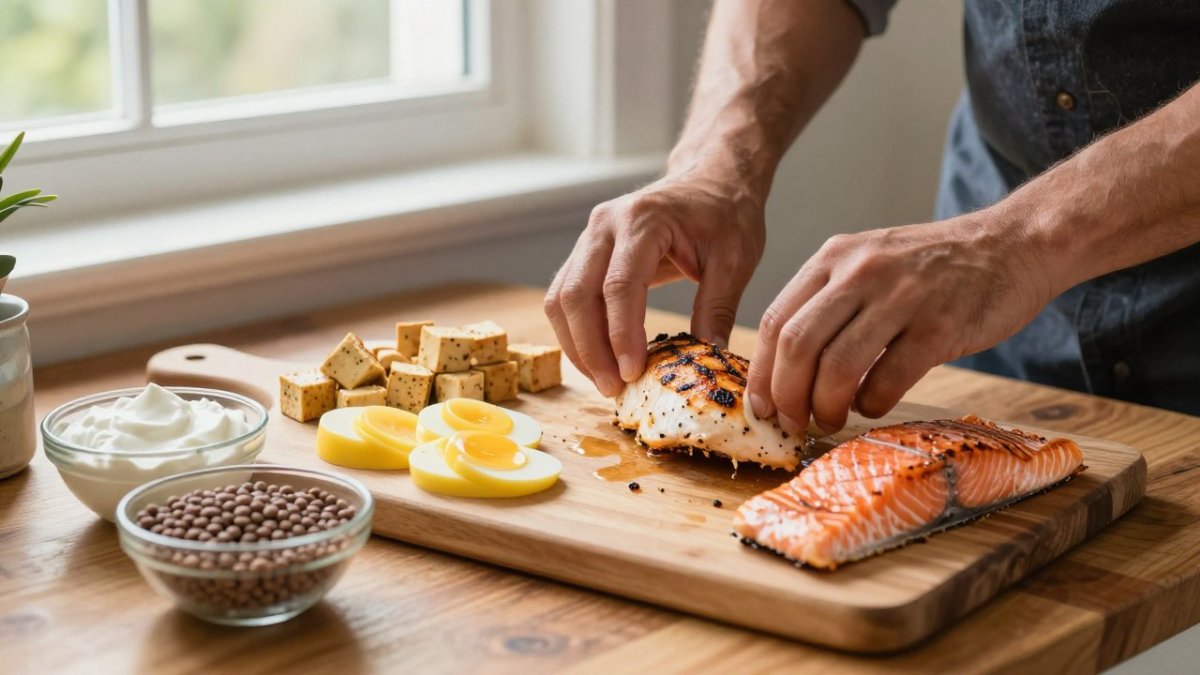
A practical anchor: aim for a palm-sized portion of protein at each meal.
Budget-friendly options deserve equal billing. For a deeper list, this breakdown of the best whole food protein sources for muscle growth covers portions and preparation.
How to Hit Protein Goals Daily Without Tracking
Hitting protein goals without tracking comes down to building meals around a protein anchor first and filling the rest of the plate afterward.
Four habits do most of the work:
- Anchor every meal: decide the protein before anything else.
- Keep two ready options: one cooked protein in the fridge, one no-cook backup.
- Use a hand measure: one palm per meal, two at dinner if training was hard.
Spreading protein intake across three or four meals is a practical way to get consistent daily totals. For no-math strategies that fit a busy schedule, these daily protein habits expand on the anchor method.
What most guides miss is that restaurant meals count.
A 7-Day Meal Plan for Muscle Gain
A workable 7-day meal plan for muscle gain repeats a small set of meals rather than introducing seven unique days. Repetition lowers decision fatigue and makes grocery shopping predictable.
| Day | Breakfast | Lunch | Dinner | Protein Anchor |
|---|---|---|---|---|
| Monday | Eggs, toast, Greek yogurt | Chicken rice bowl | Salmon, potatoes, greens | Chicken |
| Tuesday | Oatmeal with protein | Leftover chicken bowl | Lean beef stir-fry | Beef |
| Wednesday | Cottage cheese and fruit | Tuna sandwich, side salad | Tofu and vegetable curry | Tofu |
| Thursday | Eggs and avocado | Chicken wrap | Lentil and turkey chili | Lentils |
| Friday | Greek yogurt parfait | Leftover chili | Grilled fish, rice | Fish |
| Saturday | Protein pancakes | Restaurant meal, double protein | Chicken thighs, vegetables | Chicken |
| Sunday | Eggs, fruit | Leftovers | Batch-cooked protein and grains | Batch cook |
The plan is a template, not a rulebook. Swap any protein for one of similar cost and convenience. For readers who want the prep side handled, these high-protein meal prep ideas turn the template into containers.
Your 30-Day Muscle Building Diet Roadmap
A 30-day muscle building diet roadmap should move through three phases: establish baseline habits, stabilize intake, then adjust based on measured progress. Trying to do all three at once is why most beginners quit in week two.
Week 1: Baseline. Eat normally but add a protein anchor to every meal. No calorie changes. The goal is awareness.
Week 2: Structure. Set the calorie target from the calculation above and hit it four days out of seven. Build a grocery list around three proteins. Keep weighing daily and start noting training performance: how many reps you completed on your main lifts and whether you felt strong or flat.
Week 3: Consistency. Hit the calorie and protein targets five days out of seven. Add one training session if recovery allows. By now you should have two weeks of weight data, which is enough to see a trend rather than a fluctuation.
Week 4: Adjust. Review body weight trend and training performance. Add or subtract roughly 200 calories based on the trend.
Expected result: a beginner finishing this month has a repeatable meal structure, a calorie number that fits their body, and data to guide the next adjustment.
What to track and what to ignore
Track four things and nothing else for the first month:
- Body weight trend. Average your daily weigh-ins at the end of each week. Compare weekly averages, not daily numbers. A weekly average that rises 0.5 to 1 pound is on target. A weekly average that is flat for two to three weeks means you need more calories.
- Training performance. Are your main lifts adding reps or weight over four weeks? Strength trending up is the clearest sign that calories and protein are doing their job.
- Waist measurement. Measure at the navel once a week. A waist that grows faster than your weight suggests the surplus is too large.
- Adherence. How many days out of seven did you hit your calorie and protein targets? If adherence is below four days, fix the plan before changing the numbers.
Ignore daily weight swings, water weight after salty meals, and how you feel after one bad training session. These are noise. The trend over two to three weeks is the signal.
Adjustment rules for when progress stalls
Use these rules in order rather than changing everything at once:
- Weight flat for two to three weeks, training performance stable or improving: add about 200 calories per day, mostly from carbohydrates around training.
- Weight rising faster than 1 pound per week with waist growth: trim about 200 calories per day, usually from fats or evening snacks.
- Weight rising but training performance declining: you may be gaining fat without recovering. Check sleep and protein intake before cutting calories.
Watch out: changing calories every week based on a single weigh-in is the fastest way to spin in circles. Hold each change for at least two weeks before judging it.
What month two looks like
After the first 30 days, the roadmap becomes a loop rather than a sequence. Keep the calorie target that produced a 0.5-to-1-pound weekly gain, keep the protein anchor habit, and re-check the four tracking metrics every two weeks. Most beginners can run this loop for three to six months before needing a maintenance break or a short cut.
Common Nutrition Mistakes That Stall Beginner Gains
The mistakes that stall beginner gains are rarely exotic: undereating protein, overeating calories, skipping meals on busy days, and changing the plan before it has time to work. Each is fixable with a small structural change rather than more willpower.
- Protein too low: the most common stall. Fix by anchoring meals.
- Calorie target changed weekly: no trend can emerge. Hold for three weeks.
- Weekend drift: two unstructured days can erase five disciplined ones.
The tracking trap deserves its own mention. This list of common macro tracking mistakes covers the specific errors that derail people who do choose to track.
Start Making Smarter Food Decisions With Dialed In
The hardest part of muscle building nutrition is not knowing what to eat. It is making the right call in the moment, at a restaurant, in front of an open fridge, or in a grocery aisle with no time to calculate.
Dialed In closes that gap.
For a beginner running the 30-day roadmap above, that means calorie and protein targets stop being abstract numbers and become decisions at the table. Readers who want to see how the approach applies across restaurants, home cooking, and weekly planning can explore the practical food-decision guides on the blog.
Building muscle naturally as a beginner is a four-week feedback loop repeated until it becomes habit: set a calorie target, anchor every meal with protein, train consistently, and adjust on evidence rather than impulse. The nutrition principles are simple.
Frequently Asked Questions
How much protein should a beginner eat to build muscle?
Most beginners do well with roughly 0.7 to 1 gram of protein per pound of body weight per day. A 160-pound person would target about 112 to 160 grams daily. Spread it across three to four meals so each sitting delivers 25 to 40 grams. Whole foods like chicken, fish, eggs, Greek yogurt, and tofu cover this without supplements. If you weigh more and carry extra body fat, base the number on your goal weight instead.
Do you need to eat more calories to build muscle?
Yes, a small calorie surplus supports muscle growth, but it does not need to be large. Adding about 200 to 300 calories above maintenance gives your body the raw material to build lean muscle without piling on excess fat. Beginners with higher body fat can sometimes build muscle near maintenance. Track your weight weekly: gaining roughly 0.25 to 0.5 pounds per week is a good sign you are in the right range.
What foods help build muscle naturally without supplements?
Whole foods cover your needs well. Chicken breast, lean beef, fish, eggs, Greek yogurt, cottage cheese, tofu, tempeh, lentils, and beans supply complete or complementary protein. Pair them with carbohydrates like rice, oats, potatoes, and fruit for training fuel, plus healthy fats from olive oil, nuts, and avocado. These high-protein foods for muscle building also bring micronutrients that powders lack. No supplement is required for a beginner to gain muscle.
How many meals a day should a beginner eat to build muscle?
Three to four meals works well for most beginners, with each meal containing 25 to 40 grams of protein. This pattern supports protein distribution across the day, which research links to better muscle repair. Some people prefer five smaller meals; others do fine on three. The total daily protein and calories matter more than the exact meal count. Pick a schedule you can repeat consistently, since consistent eating drives results more than perfect timing.
How long does it take to build noticeable muscle naturally?
Beginners often see strength gains within four to six weeks and visible muscle changes in eight to twelve weeks. Noticeable size gains typically take three to six months of consistent training and nutrition. Early progress comes fast because beginners respond strongly to new training stimulus. After the first year, gains slow to roughly 1 to 2 pounds of muscle per month at best. Patience and steady calorie and protein intake matter more than any shortcut.
What should beginners eat before and after a workout?
Eat a meal with carbohydrates and protein about one to two hours before training, such as oatmeal with Greek yogurt or a chicken and rice bowl. This fuels training performance. After training, aim for 25 to 40 grams of protein within a couple of hours, paired with carbohydrates to replenish energy. A simple post-workout meal like salmon with potatoes or a protein-rich smoothie works. Total daily intake still matters most, so do not stress over exact timing.